Create Shapefiles from GeoJSON in Java with shapefile-creator
shapefile-creator is a lightweight library that converts GeoJSON into ESRI Shapefiles.
That is especially handy when GeoJSON is the exchange format in your application, but a downstream GIS workflow still expects a Shapefile export.
The key point is: you do not need anything else for that export. No additional GIS server, no heavyweight conversion toolchain, and no external desktop tooling in your application runtime. Just this library.
The library is published on Maven Central, so integration into existing Java or Groovy projects is straightforward.
Dependency
Gradle
implementation("de.sijakubo:shapefile-creator:0.1.0")
Maven
<dependency>
  <groupId>de.sijakubo</groupId>
  <artifactId>shapefile-creator</artifactId>
  <version>0.1.0</version>
</dependency>
Why this is useful
Shapefiles are still common in GIS tooling, data exchange, and legacy integrations.
If your application already produces GeoJSON, creating a Shapefile export should not require a heavy GIS stack.
This library focuses on exactly that use case: take GeoJSON as input and generate a Shapefile with the feature properties mapped to attributes.
That makes it a very lightweight option for teams that simply want to add Shapefile export support without introducing more infrastructure or dependencies than necessary.
Example
The following Spock test uses a FeatureCollection from input.geojson and writes the result into a temporary output directory.
The assertions verify that the expected Shapefile artifacts were created successfully:
import org.springframework.core.io.ClassPathResource
import spock.lang.Specification

import java.nio.charset.StandardCharsets
import java.nio.file.Files
import java.nio.file.Path

class ShapefileTest extends Specification {

  def "create shapefile from geojson"() {
    given:
      Resource geojsonResource = new ClassPathResource("input.geojson", getClass())
      String geojson = geojsonResource.getFile().getText(StandardCharsets.UTF_8.name())
      Path outputDirectory = Files.createTempDirectory("shapefile-test")
      GeoJsonToShapefileConverter converter = new GeoJsonToShapefileConverter()

    when:
      converter.convert(geojson, outputDirectory, "myFields")

    then:
      Files.exists(outputDirectory.resolve("myFields.shp"))
      Files.exists(outputDirectory.resolve("myFields.shx"))
      Files.exists(outputDirectory.resolve("myFields.dbf"))
      Files.size(outputDirectory.resolve("myFields.shp")) > 0
      Files.size(outputDirectory.resolve("myFields.dbf")) > 0
  }
}
Using a temporary directory keeps the example self-contained and avoids leaving generated files behind in the project workspace.
Input data
The input.geojson file in this example contains a FeatureCollection with multiple features:
{
  "type": "FeatureCollection",
  "totalFeatures": 900,
  "features": [
    { "...": "..." }
  ]
}
During export, the feature properties are written as attributes into the generated Shapefile.
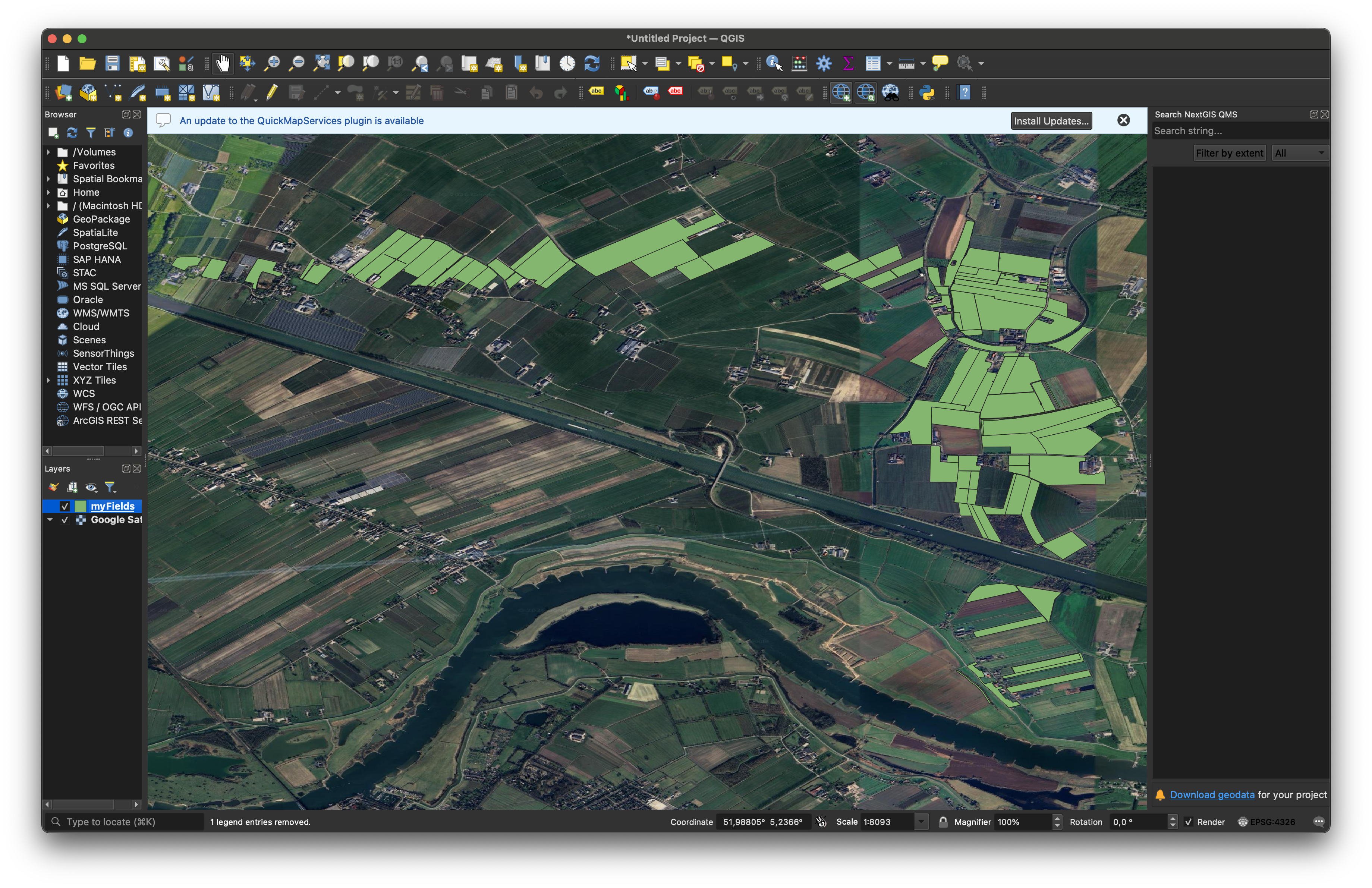
Result in QGIS
The resulting export can be opened directly in QGIS. All properties from the GeoJSON features are available as Shapefile attributes.
Conclusion
If you need a simple way to generate Shapefiles from GeoJSON in a Java or Groovy application, shapefile-creator is a practical lightweight option.
It keeps the export code small, integrates nicely into tests, and makes it easy to hand over GIS-compatible output to tools such as QGIS.
Most importantly, you do not need anything beyond this dependency to generate the export, which keeps the solution pleasantly lightweight.